A learned friend asked me this question and I was inspired to look for answers. I myself was a bit shocked that this did not cross my mind. Nevertheless. For any answer, we have to go to a accessible and understandable credible source.
Reference Text
To answer this, I have referred to the Mahabharata, specifically the simplified version by C. Rajagopalachari. I had read the book a few times in the past, easy to understand and accessible. I strongly recommend the book to whoever wants a good perspective on the epic. I could further enrich this essay with details from other advanced works of the Mahabharata later, if I wish to add the details. Back to the question
The complexity
The question of whether it was justified to ask Duryodhana for half the kingdom comes from the complex history of succession and political dynamics within the Kuru family. Dhritarashtra, as the elder son of Vichitravirya, should have rightfully become the king of Hastinapura. However, due to his blindness, Pandu, his younger brother, was crowned king. Was Pandu holding the fort for Dirtarashtra ? Then, this raises a question: Should Duryodhana, as the son of Dhritarashtra, have been considered the heir apparent instead of Yudhishthira, the son of Pandu? Furthermore, after Yudhishthira loses everything in the infamous game of dice, was the request for half the kingdom still justified?
Pandu, the King of Hastinapura
Pandu is portrayed as the actual King of Hastinapura, not just a caretaker for Dhritarashtra. If Pandu had merely been holding the fort, it would imply that he was ruling temporarily until Duryodhana was ready. However, after Pandu was cursed during a hunting incident, he handed over the kingdom to Bhishma and Vidura to manage and left to the forests with his two wives. He did not pass the throne to Dhritarashtra. After Pandu’s death alone, Dhritarashtra invariably became the king, but the administration was carefully overseen by Bhishma and Vidura.
We also need to consider that while Pandu was alive and ruling, Dhritarashtra and his family—his wife and 100 children—enjoyed the material wealth of the kingdom. This highlights the difference between kingship and property ownership, though in this reference of Mahabharata does not explicitly explain this distinction. There isn’t much known about Dhritarashtra’s exact role in the kingdom.
Kunti’s Return to Hastinapura
After Kunti returned with her five children following their birth in the forest, and after Pandu’s death, both the Pandavas and the Kauravas lived peacefully at Hastinapura. However, Duryodhana, even at a young age, grew increasingly worried that after his blind father’s death, Yudhishthira, the eldest Pandava, would ascend the throne. It became clear that Yudhishthira was widely regarded as the rightful heir. This belief led Duryodhana to make several attempts on the Pandavas’ lives, including the infamous wax house incident.
Pandavas are Alive
When Dhritarashtra learned that the Pandavas were alive after their marriage to Draupadi, he knew they would return and would ask for the Kingship. Duryodhana, aware of the Pandavas’ strength, sought advice from Karna and others on how to prevent Yudhishthira from becoming king. Karna and the rest of Duryodhana’s camp knew that the Pandavas could not be defeated in battle. Duryodhana then approached Dhritarashtra.
Half the Kingdom is Rightfully the Pandavas’ Share
Dhritarashtra consulted Bhishma, Drona, and Vidura, and they advised him that, according to legal norms, “half the kingdom” rightfully belonged to the Pandavas. This is the first instance in the epic where the concept of “lawful” inheritance is explicitly mentioned. Following their advice, Dhritarashtra had to come across as someone fair, and he quickly came up with an idea, and decided to give the Pandavas the ruined city of Kandavaprastha as their share.
Originally, everyone had assumed that Yudhishthira would inherit the throne of Hastinapura, and not a ruined city. This probably marked the first act of deceit toward the Pandavas. Dhritarashtra ordered the Pandavas to take control of Kandavaprastha and rule there. Yudhishthira was made the king of the city, which they later saw unprecedented growth and prosperity and was renamed Indraprastha. Over 36 years, the city flourished and became a symbol of wealth, prosperity, and growth.
Jealousy and Deceit
As Indraprastha grew prosperous, Duryodhana became jealous and desired to take it back. However, knowing the Pandavas’ strength, he realized that direct warfare was not an option. Duryodhana approached Shakuni for help. Initially hesitant, Shakuni eventually agreed to aid Duryodhana in his plan to undermine the Pandavas. They decided to invite Yudhishthira to a game of dice. Since the invitation came from King Dhritarashtra through Vidura, it was difficult for Yudhishthira to decline.
At the game, Shakuni rolled the dice on behalf of Duryodhana, making the game inherently unfair. When Yudhishthira pointed this out, they mocked him, and eventually, he was forced to concede as per the epic.
From Friendly Game to Loss of Kingdom
What started as a friendly game between cousins ended with Yudhishthira losing his kingdom, along with Draupadi. Dhritarashtra was condemned by the elders of the kingdom for allowing such a deceitful game, and the shameful act of what they did to Draupadi, which inturn shamed the kingdom and their ancestors. Fearing the consequences of the events, Dhritarashtra hastily decided to return Indraprastha to Yudhishthira, knowing that the Pandavas’ loss was achieved through deceit. He suddenly was overwhelmed by the karma outcomes on Duryodhana. [Krishna, later refers to this game and mentions that if he were in the congregation, he would have advised the elders then and there and avoided the unpleasant incident that followed.]
Yudhishthira and his brothers returned to Indraprastha.
Yudhishthira Invited Again to play
Duryodhana, unable to accept the outcome of his father’s decision, demanded another game. Yudhishthira was invited again, and this time the stakes were different: twelve years of exile plus an additional year in disguise. Yudhishthira lost and went into exile. There was no mention of losing Indraprastha in this second game, so it is unclear whether he was meant to lose both his kingdom and face exile. During their exile, Duryodhana took control of Indraprastha.
Post-13 Years of Exile
After the Pandavas’ 13 years of exile, a gathering was held for Abhimanyu’s marriage at Upaplavya. During the gathering, Krishna spoke about what was fair for the Pandavas, and the issue of “half the kingdom” was raised once again. Krishna highlighted the deceitful nature of the game and argued that Yudhishthira should be given back his kingdom. During the exile earlier, Balarama had expressed sorrow over how Duryodhana, despite his sin, was living happily, while Yudhishthira, who followed dharma, was suffering. However, in this instance, Balarama also believed that Yudhishthira should have known the risks of participating in the game. He stated that Yudhishthira could only request the return of his kingdom, not demand it.
Ultimately, the meeting concluded that preparations for war should begin, but Krishna would go on behalf of Yudhishthira to seek peace. Duryodhana, too, prepared for war.
Summary
In my view, the entire conversation was originally for Indraprastha alone, not Hastinapura. Even if Indraprastha had been returned to Yudhishthira (though Duryodhana had emptied the vaults by then), Duryodhana still controlled Hastinapura. Duryodhana was unwilling to part with Indraprastha, not even a “needle’s worth” of space.
Krishna’s perspective was that the entire game was deceitful, and that the Pandavas at least deserved Indraprastha. This led to the failure of peace talks and the subsequent war.When it came to war, then it became that of full inheritance and not just Indraprashta.
We must refer to advanced texts for a deeper understanding of this conclusion.
—-OM TAT SAT—-
Share the page/post with someone who would benefit by knowing about this page/post
Several sources have discussed the impact on four major planetary transits occurring between now and May 2025. So I am not going to repeat them. Saturn moves first on March 29, followed by Jupiter on May 15, and finally, Rahu/Ketu by the end of May 2025. The following advice pertains to April 2025.
Why April 2025 ?
The key period of concern is April 2025. When Saturn enters Pisces on March 29, 2025, it will be within 2 degrees of Rahu, creating the possibility of Rahu overshadowing Saturn. At the same time, Venus will be in retrograde, and soon after, Mercury will also begin its retrograde motion toward Rahu, while Saturn continues moving toward Rahu in direct motion. As a result, throughout April 2025, three planets—Mercury, Venus, and Saturn—will be under Rahu’s influence.
While the Moon crosses Rahu every month, its rapid movement (about 3 degrees in a few hours) minimizes prolonged effects. However, Mercury and Venus, despite being fast-moving planets, are moving toward Rahu instead of away from it this time. Saturn, the slowest-moving planet, is also gradually approaching Rahu, intensifying the impact. And that’s the only basis of this advisory. Now, advisory is meant to provide a caution and to make informed choices, and not to cause fear and inaction.
For individuals with Taurus, Libra (ruled by Venus), Gemini, Virgo (ruled by Mercury), Capricorn, and Aquarius (ruled by Saturn), this transit period requires extra caution.
Aries (Mesha)
Aries is under the 7.5 years of Saturn’s influence. Saturn also rules the 10th and 11th houses, indicating a need for vigilance in work. Pay close attention to home security, as the risk of theft persists. Focus on health and general matters, and avoid travel or taking important decisions on Janma Rasi/Ashtamachandra days. Be vigilant at work, avoid confrontations and arguments as it can get out of proportion. This time around, you may not get your way!
Venus is the Lord of 2nd and 7th. Be cautious on investments/savings/expenses. Mercury is the Lord of 3rd and 6th. Again, new initiatives will be delayed. So be patient. Keep a watch on the health of your spouse.
Brief note on Transit: Be more vigilant if you are running the Saturn Dasa or the Rahu Dasa. The beginning of the 7.5 years is already starting on a challenging note, so if you are in addition running these Dasas, then, there are challenges ahead. What worked till yesterday, will not work now. You have to readjust, recalibrate and overcome these challenges. Rahu in the 11th house is a good transit and further Jupiter aspecting the Rahu from May 2025 also provides relief. You will get back some of the profits back. Ketu in the 5th house will allow children to come back to your home for a brief time and this can last to 18 months
Scorpio (Vrischigam):
If you’re planning to buy a new home or relocate, make informed choices. If possible, consider delaying the process by a month. If an immediate move is necessary, ensure all documents are thoroughly verified.
Keep a close watch on children, as the shadow effect is occurring in the 5th house. Avoid crowded places with them, or ensure enough adults are present to supervise individually. The 5th Lord, Jupiter, remains outside the eclipse zone, offering some relief.
Pay attention to your mother’s health, and plan vacations wisely—especially those involving water-related adventure sports. Venus, ruling the 7th and 12th houses, indicates that your spouse’s health may require care. You might also experience unexpected expenses and sleep disruptions. To manage this, avoid overloading your schedule and approach tasks mindfully.
Mercury, ruling the 8th and 11th houses, signals the need for careful attention to both health and finances during this period.
Brief Transit Note: For Scorpio natives, relief from Kandaka Shani is on 29th March 2025, bringing overall ease after April 2025. In May 2025, Jupiter will transition into the 8th house (Ashtama Guru). While this position is not traditionally favorable, Jupiter, being a benefic planet for Scorpio, will still provide financial protection, influencing both expenses and savings. Additionally, Jupiter’s aspect on the 4th house—where Rahu will transit in May 2025—suggests a positive shift. Though Ashtama Guru presents challenges, Jupiter’s presence ensures a degree of stability and support.
Taurus (Rishabha)
For Taurus (Vrishabha) natives, this transit period requires careful attention to work, finances, and family matters. Saturn, ruling the 9th and 10th houses, may bring challenges to professional life, necessitating focus, caution, and diligence in handling responsibilities. Father’s health should be closely monitored. Mercury rules over the 2nd and 5th houses require financial vigilance, also in matters related to family, wealth and children. Be cautious with online transactions, banking, and digital payments to avoid fraud. Avoid travel on Janma Rasi/Ashtamachandra days, and exercise caution when signing documents. Important decisions should not be rushed to prevent accidents or mishaps. Plan family vacations around planetary relief dates to minimize disruptions.
Brief note on Transit: It’s important to remember that you are currently under the influence of Janma Guru, which may be contributing to mental tension. However, this phase will end in May 2025, bringing much-needed relief.
Saturn will move into your 11th house, but in April 2025, it will be under the shadow of Rahu, which could create challenges related to profits and finances. Stay vigilant in all financial matters during this period. As Saturn is the Lord of the 9th and 10th houses, he will bless you with good outcomes throughout the next 2.5 years. You will see a return of profits, wealth and happiness.
Rahu’s transit into your 10th house may give a sudden rise, and also sudden fall, you will be much protected by Jupiter in the 2nd house who by then will be aspecting Rahu., While Ketu’s movement into your 4th house could impact your home life. If you have been living away from home and have applied for a transfer, opportunities for relocation may arise starting in June 2025.
Additionally, in May 2025, Jupiter will transit into your 2nd house, offering significant relief. Its aspect on Rahu in the 10th house will help stabilize career-related matters and financial growth.
Libra (Thulam)
For Libra (Tula) natives, this period emphasizes security, financial caution, and family well-being. With Saturn governing the 4th and 5th houses, extra care should be taken regarding home safety and children’s well-being. Ensure that security measures, such as cameras, are in place, and house-related documents are handled carefully. Financial caution is needed due to Mercury’s Lordship over the 9th and 12th houses. Father’s health may require attention, and regular check-ups are recommended. Avoid impulsive spending, and ensure financial decisions are well thought out. Venus governs 1st and the 8th house, so you must be extremely mindful as your Rasi Lord is unable to fully support you.
Brief note on Transits: You are currently under the influence of Ashtama Guru, and it will take another two months to fully recover from the effects of the previous year’s transit. However, relief is on the horizon. With Jupiter transiting into your 9th house, it will positively aspect your Rasi and 5th house, bringing stability and growth.
Adding to the good news, Ketu will move out of your 12th house by the end of May, marking a significant turning point. This combined transit will offer much-needed relief, helping you finally see success after the challenges you’ve been facing.
Saturn’s shift into your 6th house will strengthen you, boosting confidence and happiness. However, since Saturn is your 4th Lord moving into the 6th house, there is a possibility of legal matters arising. Additionally, if your children are at the right stage in life, they may move out of the home during this period.
With Ketu exiting the 12th house, you will experience reduced mental tension, improved sleep, and better financial control. Your spending is likely to shift toward things that genuinely enhance comfort and well-being.
Gemini (Mithunam)
For Gemini (Mithuna), Saturn’s influence over the 8th and 9th houses highlights the need for attention to personal well-being, Health and the health of the father. Venus, ruling the 5th and 12th houses, suggests controlling expenses and overseeing children’s safety and well-being. Financial commitments should be delayed until after planetary relief. Avoid travel on Janma Rasi/Ashtamachandra days and exercise caution with important decisions to avoid accidents or mishaps.
Brief note on Transits: It’s important to note that Saturn is transiting into your 10th house, marking the beginning of Kandaka Shani. However, this phase starts with a tormented Saturn under the shadow of Rahu, making it crucial to exercise extra caution at the start of the transit, as its effects could be long-lasting. Additionally, Rahu will be in your 9th house, potentially distancing you from religious beliefs, which may not be favorable for the next 18 to 28 months. You will also experience Janma Guru, with Jupiter positioned in your birth Rasi. You will start worrying for simple aspects, about your family members, and will have the tendency to make incorrect or impulsive decisions. On a positive note, Ketu’s movement into the 3rd house will provide some relief, serving as the only silver lining during this period
Virgo (Kanni)
For Virgo (Kanya), Saturn’s rule over the 5th and 6th houses indicates potential challenges at work and in responsibilities toward children. With Venus governing the 2nd and 9th houses, savings and financial planning should be approached cautiously, and father’s health should be closely monitored. Avoid travel on Janma Rasi/Ashtamachandra days and exercise caution when signing documents. Avoid rushing through important decisions to prevent accidents or mishaps.
Brief note on Transits: For Virgo, the Saturn transit into the 7th house also called Kandaga Shani is not favorable for relationship with your spouse. However, this phase starts with a tormented Saturn under the shadow of Rahu, making it crucial to exercise extra caution at the start of the transit, as its effects could be long-lasting. Trivial fights caused by others will have a unprecedented impact on your relationship. Also, Ketu in May is transiting into your 12th house, further causing sleeplessness, expenses and even hospitalization. Jupiter in a Kendra from Virgo will provide some relief but it is going to be a challenging 18 to 30 months.
Be more cautious if you are running the Dasa of Saturn, Rahu, Guru or Ketu.
Cancer (Katagam)
For Cancer (Karka), Saturn’s ruling over the 7th and 8th houses highlights the need for attention to personal and spouse’s health. Mercury, ruling the 3rd and 12th houses, suggests caution regarding major expenses and delaying significant financial commitments. Younger siblings may need extra attention. Venus governs the 4th and 11th houses, and there is a risk of financial setbacks, including theft or unexpected losses. Family dynamics, particularly with elder siblings, may also require attention. Avoid family travel in April, as planetary influences indicate potential disruptions. Change of home must be considered mindfully.
Brief Note on Transits: You’ll be relieved to know that you are coming out of Ashtama Shani. However, Rahu’s entry into the 8th house is generally not favorable. Fortunately, Jupiter’s transit to Gemini, your 12th house, will bring some protection by aspecting Rahu and stabilizing the 8th house’s influence.
With Jupiter in the 12th house, your expenses will be directed toward comfort and well-being, ensuring that your spending serves a meaningful purpose. However, Ketu’s presence in the 2nd house may impact your financial stability. Be cautious with investments and avoid dipping into long-term savings for daily expenses.
Leo (Simha):
Saturn, ruling the 6th and 7th houses, is directly under the shadow of Rahu in April 2025. Extra caution is needed while driving for both yourself and your spouse. Attend to any fever promptly. Avoid travel on Janma Rasi/Ashtamachandra days. Ashtamachandra is extremely crucial as Moon also will be eclipsed and this not only applies to you this month, but throughout the transit.
Focus on health, and avoid eating outside or traveling to unclean places. Be mindful of health and avoid attempting anything new during this month. Venus is the ruler of 3rd and 10th responsible for new initiatives and work. So be prepared for delay and do not rush into anything new. Wait patiently. Mercury is the ruler for 11th and 2nd house. Large purchases/investment decisions can wait till the month end. Pay advance if needed but wait.
Brief notes on Transit: You are entering Ashtama Shani, a period that requires extra caution, as its effects can be long-lasting. This phase begins with Saturn under the shadow of Rahu, making the initial months particularly intense.
Additionally, Ketu will move into your Rasi, while Rahu shifts into your 7th house. This combination may lead to conflicts with your spouse, increased mental tension, errors in judgment, and heightened anger. Practicing patience and mindfulness will be crucial during this time.
Jupiter’s current placement in the 10th house is unfavorable, but by the end of May, it will transit into your 11th house, bringing much-needed relief. This shift will unlock pending rewards, promotions, profits, or previously inaccessible finances.
Overall, the next 30 months will be challenging, but Jupiter’s influence will provide occasional periods of respite, helping you navigate this phase with greater stability.
Pisces (Meena):
Saturn is moving into your Janma Rasi, casting its impact directly on Pisces. This month, exercise caution in all aspects of life—travel, relationships, documentation, and safety. However, with your Rasi Lord positioned in the 3rd house, outside of this shadow effect, you will find some relief.
Venus, the ruler of your 3rd and 8th houses, may cause delays or stalls in new initiatives. Be mindful when investing your time, effort, or money in the early stages—keep commitments minimal and wait until April for more informed and relaxed decisions.
Mercury, governing your 4th and 7th houses, suggests that business partnerships may not be ideal at this time. If considering one, proceed with caution, especially in April. Additionally, avoid traveling with family, and plan vacations thoughtfully.
Brief note on Transit: You are now in the second phase of Saturn’s 7.5-year cycle (Sade Sati). If you stay mindful in early April 2025, when Saturn will be under the shadow of Rahu, you can help moderate its effects. The good news is that Ketu moving into your 6th house in May will bring some relief. However, with Rahu transiting into your 12th house, you may face unexpected expenses, heightened desires, and a tendency toward luxury. Stay vigilant and manage your finances wisely. Brace up for 5 years of challenges and equip yourself with prayers and healthy habits.
Sagittarius (Dhanur)
New initiatives may face delays, so it’s advisable to avoid significant investments until after April 30th. If necessary, you may pay an advance, but refrain from pushing too hard for immediate results. Exercise caution with house-related matters and avoid exchanging important documents.
Prioritize your health and avoid travel or making major decisions on Janma Rasi or Ashtamachandra days. Venus, as the ruler of your 6th and 11th houses, suggests potential health concerns—if you experience fever or discomfort, consult a doctor immediately. Financial gains may diminish or be lost, so remain vigilant.
Mercury, ruling your 7th and 10th houses, highlights the need to monitor your spouse’s health closely. At work, proceed with extreme caution—minor issues could escalate unexpectedly.
Brief note on Transit: Saturn will move into your 4th house as Kandaka Shani, marking a phase of challenges. This transition begins with Saturn under the shadow of Rahu, making April 2025 a particularly crucial time to stay cautious. Avoid taking anything for granted, and focus on prayers, good habits, and a charitable mindset to navigate this period smoothly.
Ketu’s presence in the 9th house may bring certain obstacles. In May 2025, the transits of Rahu and Jupiter will provide much-needed support. As your Rasi Lord, Jupiter will directly aspect your sign for one year, bringing relief in health matters, unlocking pending finances through its 11th house aspect, and blessing your 3rd house of initiatives.
Rahu’s placement in the 3rd house is generally favorable, but ensure that any new ventures are backed by a practical reality check—distinguishing between what is truly important and what is not. With mindful decision-making, this period can still bring progress despite initial challenges.
Capricorn (Makaram)
Capricorn (Makara) natives should focus on work, family, and health, as Mercury rules the 6th and 9th houses, and Venus influences the 5th and 10th houses. Professional matters require extra diligence, and family-related responsibilities, particularly concerning children and father’s health, should not be neglected. Avoid travel on Janma Rasi/Ashtamachandra days and exercise caution with important decisions.
Brief Transit note: However, after March 2025, you will be fully relieved from the effects of Sade Sati (7.5 Saturn), bringing a sense of ease.
In May 2025, Jupiter will move into the 6th house, while Rahu and Ketu will transit the 2nd and 8th houses, respectively. While relief from Saturn’s influence is significant, these planetary shifts will introduce new challenges. Be especially mindful of financial decisions over the next 18 months. A luxurious wedding or an opportunity for home improvement may arise unexpectedly—carefully assess your needs versus wants before making major commitments.
Prioritize your health during this period. Consider undergoing a full medical check-up and consulting your doctor to prevent or minimize potential health concerns and hospital visits.
Aquarius (Kumbham)
For Aquarius (Kumbha), Mercury’s influence over the 5th and 8th houses suggests that unexpected events may arise, requiring patience and careful handling. Venus, ruling the 4th and 9th houses, indicates that parental health—especially that of your mother and father—should be a priority. Keep a close watch on children’s well-being as well.
Avoid traveling on Janma Rasi/Ashtamachandra days, and exercise caution when making important decisions. Saturn, the Lord of your Rasi, is coming directly under the shadow of Rahu in the 3rd house, which may cause delays or disruptions in new initiatives.
Brief Transit Note: While Saturn is your Rasi Lord, it also governs the 7.5-year Sade Sati period, bringing both challenges and blessings. In May 2025, Rahu will transit into your Rasi, potentially causing fever-like symptoms and increasing your inclination toward excessive leverage. To navigate this period smoothly, practice mindfulness, meditation, and other calming techniques over the next 18 months.
On the positive side, Jupiter’s transit into your 5th house will provide significant relief and help counterbalance Rahu’s influence, bringing stability and support.
Ketu’s placement in the 7th house may facilitate reconnection with your spouse, especially if you have been living in separate locations. If you have applied for a transfer, it is likely to come through. However, be mindful of your spouse’s health, as it may require extra care during this time.
Remedies (For all rasis)
Focus inward. It is a good time to focus inward
Visit the Lord Shiva Shrines
Visit the Vishnu-Lakshmi Shrines
Visit Kalabhairavar and Durga temples
Be mindful
Go for long walks
Share the page/post with someone who would benefit by knowing about this page/post
I had the privilege of consulting with Roshnie, and the experience was nothing short of exceptional. From the very beginning, her professionalism and profound knowledge were evident.
Accuracy of Readings: Roshnie demonstrated an impressive ability to provide detailed and accurate readings. She quickly pinpointed key aspects of my life, offering insights that were both profound and relevant. Her interpretations of planetary positions and their impacts were spot-on, reflecting a deep understanding of astrology and its nuances.
Consultation: The consultation was highly engaging and informative. Roshnie took the time to listen to my concerns, asked thoughtful questions, and provided clear, actionable guidance. Her communication style was both empathetic and precise, making complex astrological concepts easy to understand. I appreciated her patience in addressing all my queries and her willingness to delve into specifics.
Remedies: One of the standout aspects of Roshnie’s service was her approach to remedies. Her suggestions were practical, tailored to my personal circumstances, and grounded in a clear understanding of how to align with astrological influences. The remedies she proposed were not only effective but also resonated with me on a personal level, which I believe contributed to their success.
Overall Experience: My overall experience with Roshnie was outstanding. Her expertise, coupled with her genuine care for her clients, made the entire process smooth and enlightening. I left the consultation feeling empowered and with a clear sense of direction, thanks to her insightful guidance.
If you are looking for an astrologer who combines deep astrological knowledge with a compassionate and practical approach, I highly recommend Roshnie. Her skill in reading charts and offering meaningful remedies is truly exceptional.
-KJ, IT professional, Bangalore
Share the page/post with someone who would benefit by knowing about this page/post
This is Dharanija, an Architect, 50 years of age. I had reached out to Roshnie referred by my client as I was having lots of personal and professional hickups. I am a regular with Astrologers. However Roshnie gave me a different and more scientific outlook to how and why there are instances happening and what I could do that can ease whats going on. She gave me a very extensive report on the various aspects and I refer to it even today . I would definitely recommend Roshnie to all my near and dear ones.
Dharanija, Architect
Share the page/post with someone who would benefit by knowing about this page/post
Intuition is the ability to understand something instinctively, without the need for conscious reasoning. Vedic Astrology relies heavily on astronomical data to determine the quality of time and is well-integrated with anthropology. This integration makes intuitive inference seem unnecessary. The fact that astrologers require the date, time, and place of birth to build a horoscope shows that astrology is fully based on data.
However, many astrologers are intuitive. The source of this intuition is not well understood; it may arise when meeting a client or when a specific question is asked. From an astrologer’s perspective, intuition helps focus on a specific area, allowing the use of data to confirm the insights provided by intuition. Therefore, intuition should not be directly used to predict or guide a client in astrology. Instead, it should be channeled through data, validated, and then presented carefully to the client.
What Happens If the Birth Details Are Incorrect or Unavailable?
In cases where the time, date, and place of birth are incorrect or unknown, astrologers are guided to use another technique called Prashna. This method involves using the exact time when the question is asked to find an answer to one urgent or sincere query. This method is also data-driven and is designed for answering one specific question. I do not use it for general predictions like those based on birth details. Common questions include: “Will I recover my lost items?”, “Will I pass the exam?”, “Will I get the job opportunity?”, “How critical is someone at the hospital?”, or “Will we be relieved from a specific pain?” We are usually able to provide a comprehensive answer to the question rather than just a simple ‘Yes’ or ‘No’. Prashna Marga is a specialized technique with different rules from personalized horoscope reading. Astrologers who practice Prashna Marga are often intuitive, but they rely on data from the technique to answer queries rather than solely on their intuition. Prashna is a vast subject, and I shall write a separate blog on it, as in this blog we are discussing the role of intuition.
Conclusion
In conclusion, while Vedic Astrology is fundamentally data-driven, intuition plays a complementary role that enhances the astrologer’s ability to provide insightful guidance. The precise use of birth details and the application of techniques like Prashna highlight the importance of accuracy and structured methodologies in astrological practice. However, the intuitive abilities of astrologers act as a bridge, helping to additionally look for supporting data points and refine the analysis and conclusions. Intuition by itself is not of any value; it must be channeled and validated through rigorous methods to become a valuable tool in the astrologer’s repertoire. It’s important to note that intuition does not qualify or disqualify an astrologer; rather, it serves to augment the data-driven approach. This synergy between data and intuition underscores the holistic nature of astrology, blending empirical evidence with human insight to offer comprehensive guidance.
Share the page/post with someone who would benefit by knowing about this page/post
I wish to thank Roshnie of Starise for providing me the much needed relief when I went to consult her during the pandemic. A time when things were not really going well for me in my professional & personal life. There was always a troubled mind more worried about financial stability and therefore a dependent personal stability. I was stressed, giving rise to unhealthy lifestyle diseases & was finding myself more stressed. Ifound her to be quite objective in trying to uncover latent needs before she analysed my birth horoscope and came back to me with a professional consultative approach balancing expectations and outcomes, one of her predictions about me getting a bigger break within my own organisation or outside the organisation by Sept 2024 is almost coming true. I am slated for a greater responsibility role very soon.
RV, 53 years, Senior Management Professional
Share the page/post with someone who would benefit by knowing about this page/post
Adversity pushes one’s belief systems to seek alternates and that was how I reached out to Roshnie some five plus years back. Roshnie is my ex-colleague and I knew her for more than a decade now and knew that she was STUDYING ASTROLOGY for many years. Being a believer of education , I sought Roshnie’s wisdom and advice, and not predictions. However, she came back to me with a mini report “predicting “ what might happen to me over the next few years, combo of positives and negatives. I was in fact thrilled to read through the details and I sensed what she says may be true as it fit my strategy too. She also advised me what I should and what I should NOT do and what will work for me and what will NOT work for me. That piece Of advice was legend and classic. I felt that right too and I did follow. Shortly in few years, things were changing to my advantage and I witnessed things moving the way Roshnie was predicting and was quite pleased. This lead to me seeking her advice and wisdom for my daughters too and there again she advised few aspects during pivot decision making’s and trust me that is helping me too.
Over the last five plus years Roshnie has become our “family astrologer (advisor)”.
I keep saying her to become a full timer into astrology and help many. Hope she does and wish her all the very best.
Cheers, Mega
Share the page/post with someone who would benefit by knowing about this page/post
The Indian calendar is intricately and accurately tied to astronomical events, fascinatingly influencing even our understanding of the days of the week—from Sunday to Saturday—a topic I will delve into in an upcoming blog. Today, however, I focus on how our birthdays align with astronomical events, recurring beautifully each year. While the Gregorian birth date also occurs annually, this article explores the unique aspects of these systems and provides insights into how we can embrace and celebrate birthdays according to both calendars.
Birthday as per Gregorian calendar
The Gregorian calendar, introduced by Pope Gregory XIII in October 1582, is the most widely used calendar globally today. It incorporates astronomical events such as the Earth’s orbit around the Sun, rounding off for practical ease rather than aiming for pinpoint accuracy. This simplifies the tracking of anniversaries such as birthdays, approximating their annual occurrence based on the Earth’s orbit. Despite this approximation, the calendar provides a stable and widely accepted framework for organizing events globally, ensuring consistency in scheduling international activities and holidays. Therefore, the return of the birth date in a given month is celebrated as the birthday.
Birthday as per the Indian Calendar
In contrast, the Indian Calendar is deeply rooted in astronomical observations of the Sun, Moon, Earth and the 27 fixed stars. These stars, which remain fixed in the sky, serve as reference points for tracking planetary movements and their mutual distances. When a child is born, these astronomical events are noted, and we await the recurrence of the same celestial alignment the following year, termed as the Star Birthday or Nakshatra Birthday. A child’s birth is celebrated based on the solar month and the specific Nakshatra (constellation) under which the Moon resides during its orbit around the Earth. This unique alignment recurs annually, marking the significance of the Star-Birthday or Nakshatra-Birthday.
Is this relevant today?
Ancient scriptures emphasize the rarity and sanctity of human birth among the multitude of species on Earth, considered a blessing or the fruit of virtuous deeds. The celebration of birthdays reflects this reverence, akin to the cyclic unity of the Moon with its Nakshatra during its waxing and waning phases relative to the Sun and Earth. Traditionally, birthdays are observed with gratitude for life’s opportunities and are marked by spiritual introspection, prayers, and acts of charity towards the less fortunate.
Celebrating Both Birthdays
The Gregorian calendar-based birthday becomes an occasion for festivities with friends, family, and colleagues, celebrating the joy of existence and accomplishments. It plays a significant role in the social fabric, fostering bonds and marking milestones in life.
Conversely, the Indian Calendar-based birthday offers a moment for personal reflection, spiritual growth, and connection with the universe at large. This day holds a deeper significance for inner contemplation and seeking spiritual insights. Experiential wisdom advises us to utilize this time wisely for inner peace; when the Moon aligns in the same degree as during birth, it suggests a heightened sensitivity and caution. It reminds us to tread carefully in travel, decision-making, and other important matters, emphasizing the need for a secure and stable environment. Therefore, traditionally, it is observed quietly with visits to temples, religious rituals, a home-made feast, and seeking blessings from elders and the family deity, as well as by being benevolent and charitable towards others less fortunate.
Every 19 years, the Gregorian calendar’s approximation corrects itself to align with cosmic events, meaning that on the 19th birthday, both the birthdate and the Star birthday will coincide. It is recommended to focus on activities suitable for the Star birthday on this occasion, while celebrating socially at a later time as expected.
By choosing the right activities, we are able to leverage both these days to our benefit.
How to know your birth star ? How to know its annual return ?
To find your Nakshatra, you can refer to your horoscope or use online tools readily available. Determining its annual return date involves consulting an almanac or Indian calendar, which may require familiarity with these resources. I offer assistance in finding your Star Birthday and provide details of its next two occurrences through a simple form, with no charges incurred. All you need to do is fill up the form here
In the future, I plan to equip you with tools to identify this on your own through a self-service blog. Rest assured, your privacy is my priority, and any data shared will solely be used for providing the requested information.
Share the page/post with someone who would benefit by knowing about this page/post
This article is written based on my first visit to the temple in August 2022 and is meant to provide a basic guideline for 1st time travelers. I have updated it as on 18th June 2024 to include some more information. I plan to do more visits and will be updating this article with more information.
YOGA NARASIMHAR TEMPLE, SHOLINGUR, THIRUKADIGAI
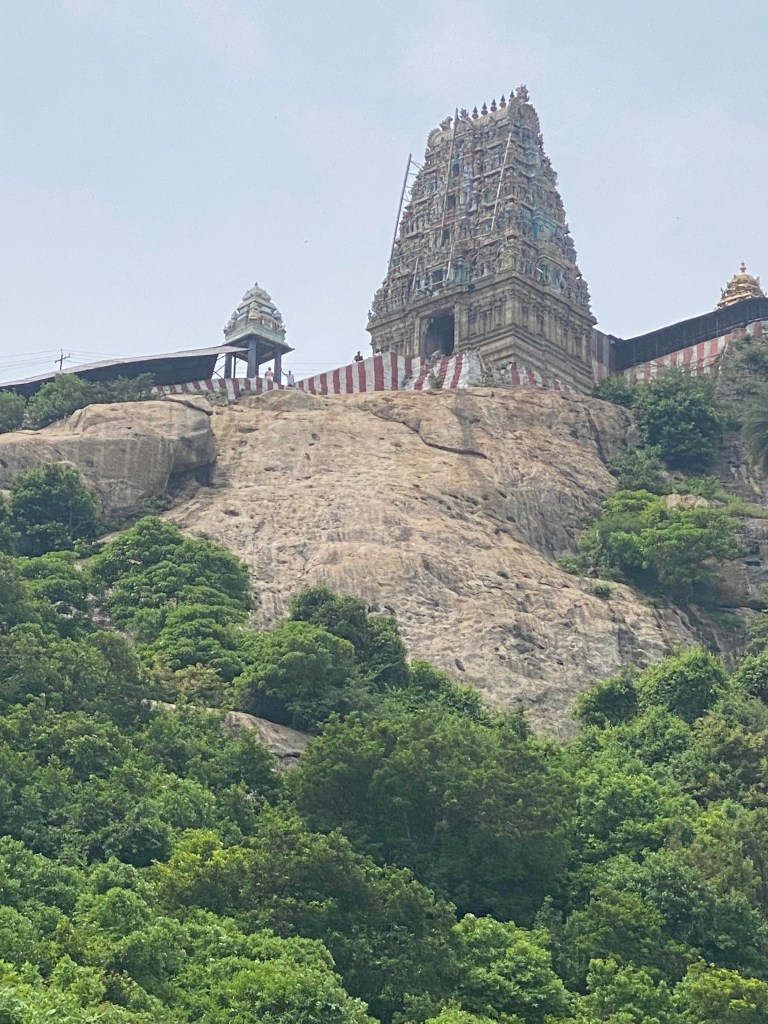
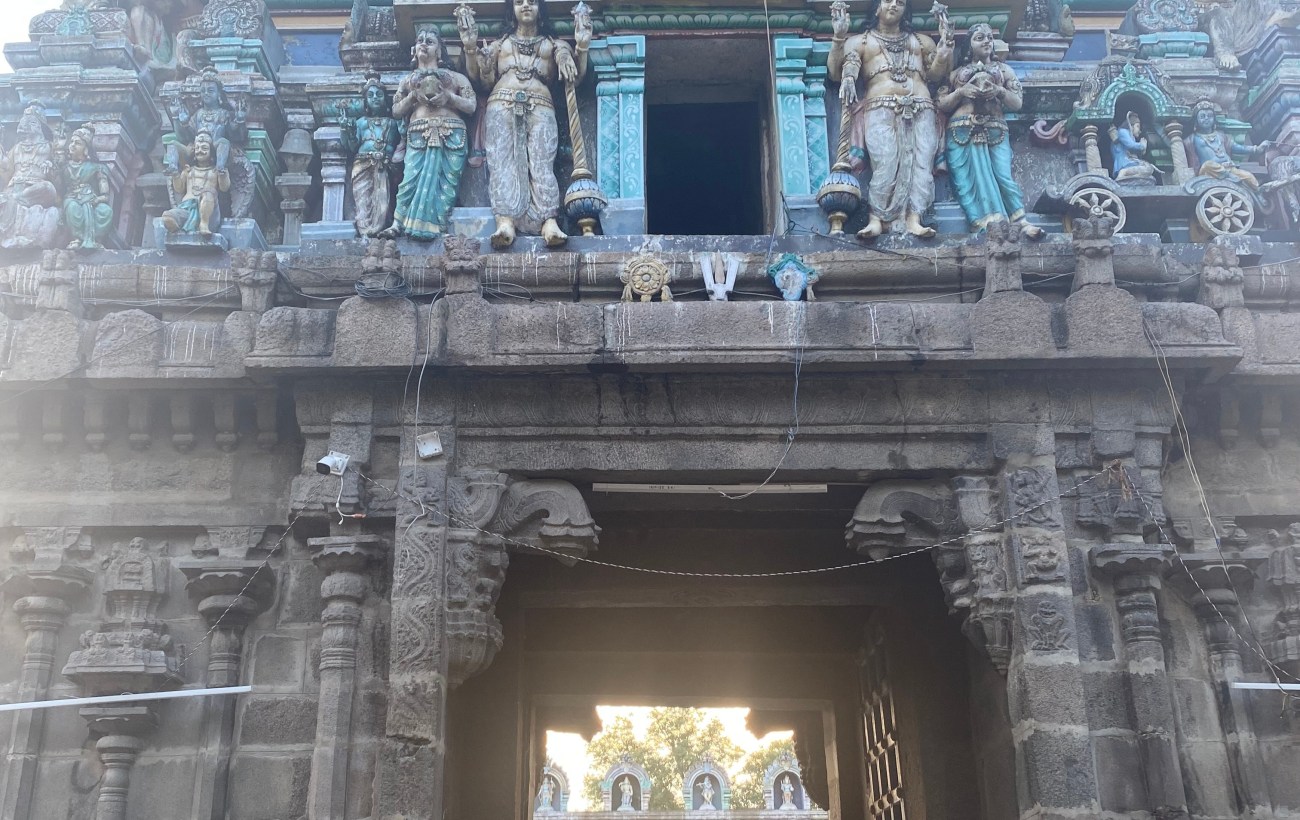
The Yoga Narasimhar Temple in Thirukadigai is revered as the 64th Divya Desam among the 108 Divya Desams. Located approximately 100 kilometers from Chennai and 30 kilometers from Tirutanni, our journey began at 5:30 am from Chennai, reaching Tirutanni by 8 am.
We searched for a breakfast spot in Tirutanni but found few options. Eventually, we settled for the only available hotel. We recommend packing a light breakfast from home to save time and ensure you have enough energy for the intense climb. Climbing on an empty stomach is not advisable, especially for those unfamiliar with the terrain or those with health concerns.
The temple opens at 8 am, and it’s best to arrive at the foot of the hill between 7:15 am and 8 am. At the entrance to the holy hill, we purchased a stick for Rs. 10 to ward off monkeys if you plan to hike by foot. Most recently, an article was published that the rope car facility was being inaugurated, which was not available when I visited.
Monkeys abound at the temple, often in large numbers. They have a knack for taking away anything you carry, aside from your devotion. This serves as a metaphorical reminder that in spiritual life, our desires can similarly be taken away. Monkeys are known to snatch water bottles, cola drinks, flowers, garlands, and food items from visitors.
Observing their behavior is quite fascinating. For instance, if they get hold of a coconut, they first make a small crack to access the water. Later, they break it into pieces to share among their groups.
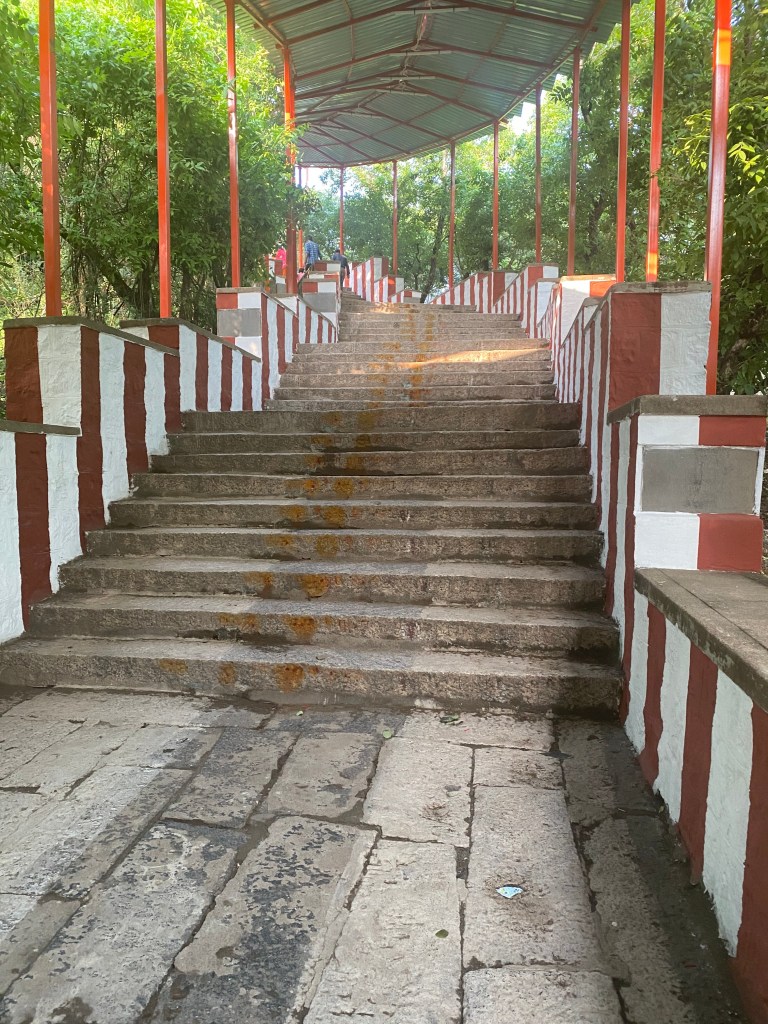
The 1305 holy steps
Right at the entrance to the steps stands the Anjaneyar Temple, a must-visit before beginning the ascent. The staircase itself consists of precisely 1305 clean granite steps, each sheltered with a roof for comfort. The climb typically takes about an hour and a half at a comfortable pace, with milestones marking every 100 steps along the way.
During the ascent, there are two pitstops offering bottled water and cold drinks, as well as free water stations provided by the temple, which appeared safe to drink. Given the steepness, we made use of both pitstops for refreshment.
Notably, these steps were the sole route to reach the temple. We observed a few swing-type palanquins manually carrying senior citizens, providing an alternative for those unable to climb. But now, the rope-car facility seems to have been open. Kindly explore before you start you hike.
At the temple
Upon reaching the temple, the path to the right leads to the free darshan area, while the left leads to the paid section. Despite our search, we couldn’t locate the ticket counter, so we proceeded to the right. Visiting on Ekadesi day meant there was a queue, but we were able to glimpse Amritavalli Thayar first. Despite the crowd, there was space to linger and admire the goddess a bit longer.
Moving along the queue towards the Sanctum of Yoga Narasimhar, we encountered the rare sight of the Sapta Rishi, meditating and facing the Lord—an unforgettable first-time experience for me. The profound joy of seeing Yoga Narasimhar after climbing 1305 steps was overwhelming.
On the return, we were fortunate to see Amritavalli Thayar once more, this time with fewer visitors, allowing us another peaceful moment with her.
A few highlights of the temple
Divya Desham – 64th of 108: Recognized as one of the 108 Divya Desams, this temple holds the prestigious position of being the 64th.
Yogic Posture of Lord Narasimha: The deity Lord Narasimha is seated in a yogic posture, hence the temple’s name “Yoga Narasimhar Temple.” Amrithavalli Thayaar also resides here alongside him.
Thirukadigai: Vishwamitrar attained the title of Brahma Rishi within one ‘Kadigai’ (24 minutes or one Nazhigai) at this sacred site, leading to its name “Thirukadigai.”
Darshan of Saptarishis: The Saptarishis (Seven Sages) sought to behold Lord Vishnu in his Narasimha form here. They were blessed with his darshan within the span of one ‘Kadigai’, highlighting the temple’s spiritual potency.
Climb down
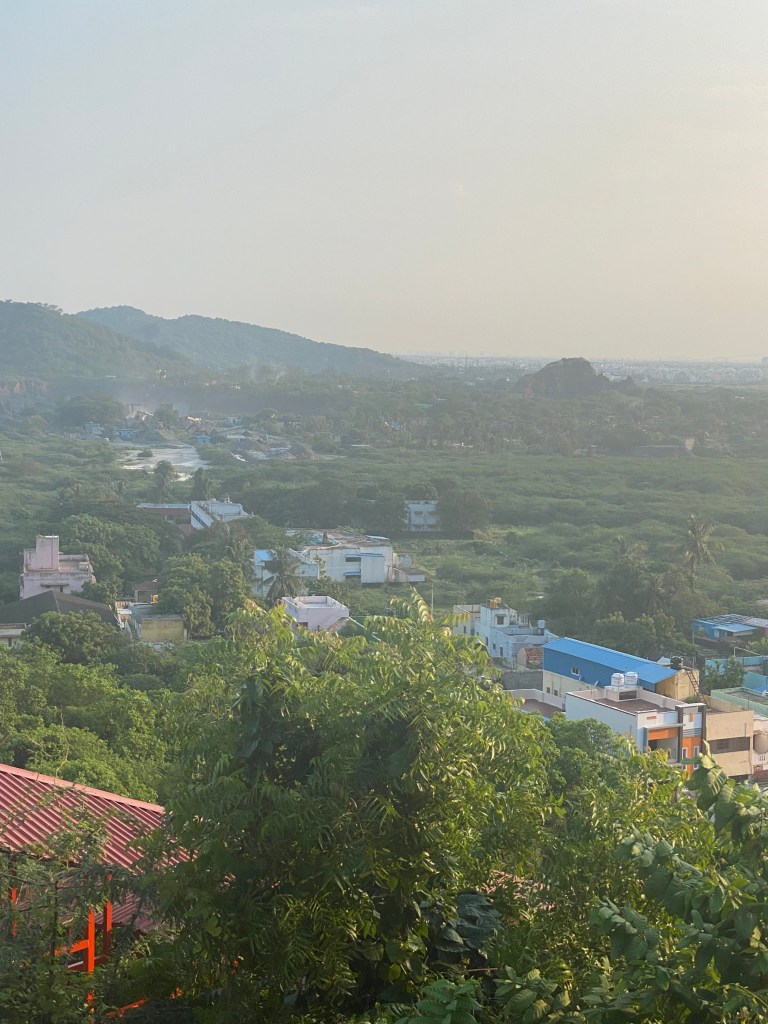
After our customary sit at the temple, we began our descent. The view from the top is truly unmissable, and the climb down took us the same amount of time.
During our descent, a thought-provoking question arose from my friend: Do you articulate your wants and desires before praying or visiting temples? In short, yes. Each of us holds varying perspectives shaped by our life experiences. Personally, I recommend exploring the insights in “Prayer Guide” by Swami Dayananda Saraswathi, published by Arsha Vidhya Ashram, for further understanding.
The Yoga Anjaneyar Temple
‘The Yoga Anjaneyar Temple’ is situated in the adjacent hill. It has 400+ steps. More details on that later.
Share the page/post with someone who would benefit by knowing about this page/post
I discovered online that 84 of the 108 Divyadesam are in Tamil Nadu. I visited the 61st Divyadesam on the 28th of August 2022, the dual temples in Thiruneermalai. Thiruneermalai is 18 kilometers from Adyar, Chennai, and about 7 km from the airport. Yes! In our backyard (for the readers who reside in Chennai). I started at 4:15 pm and reached in a little over half an hour. The route is straightforward. Drive straight from the airport, take a right at the Pallavaram Junction, and drive further for a couple of kilometers. The temples open at 5 pm and close at 8 pm. The Neervanna Perumal temple is at the foot of the hill, and the Ranganatha Perumal temple is at the top. The temple’s uniqueness is that Lord Vishnu has appeared in four postures at this very place.
Reaching the temple
Giant Chariot
The road that leads to both the temples can be deceptive; I circumambulated the hill in my car once before I spotted the giant chariot. You have to take a right at the chariot.
Parking
There is ample space to park in and around the hill. However, there are several kalyana mandapams close to the temple. Since 28th and 29th were auspicious days, there were several incoming cars. However, since I reached early, I found a decent parking spot. I choose to visit the temple at the top of the hill first.
Steps and the climb
300 easy to climb sheltered steps with walking platform in between
There are three hundred steps to the hilltop. There is no other way to reach the hilltop. There are no pit stops or monkeys(compared to Thirukadigai Yoga Narasimha Temple), so you can carry your water and offerings as you please. The weather was perfect that day. As soon as you climb a few steps, the Hanuman Shrine is to the right. You might miss the spot if you do not know how to read Tamizh.
Indication to take right for the Hanuman Shrine
Shri Rangnatha Permual Sanctum
Shri Ranganathar Temple Entrance at the hilltop
I reached at 5:15 pm at the hilltop. There are a few more steps to the sanctum as soon as you enter. You don’t have to go to your right or left, as the stairway can be seen right before you. You will receive darshan at the Sri Ranganatha Perumal first. Sri Ranganatha Perumal is reclined on Adishesan, with Lord Brahma springing from his navel (Nabhi Kamalam); Goddesses Sridevi and Bhudevi are seated at his feet. The priest take the effort to direct you to all the divinities inside the sanctum. He repeats the details for every group of devotees walking in. Follow the directions of the priest. You will also be able to receive the darshan of sages Brigu Maharishi and Markandeya Maharishi within the sanctum.
Since it was not that crowded when I reached, I had the opportunity to pay obeisance to Shri Ranganathar for a longer time. I have not experienced such a close-up or proximity to darshan anywhere. I got lucky that day; the priest stepped out for a minute, and there were no other devotees; it was just Ranganathar, and he mesmerised me. I stood in admiration.
Sri Ranganayaki Sanctum is on the right as you exit, at the same level, as mesmerising as Shri Ranganathar. The temple’s structure is so that the other two shrines have a short climb as you circumambulate the Shri Ranganathar sanctum. We arrive at the Shri Shanta Narasimhar Sanctum next.
Shri Shanta Narasimhar Sanctum
Shri Shanta Narasimhar is sitting calmly. You can also see a child-like Narasimhar deity; Shri Narasimhar appeared in his calm composure for the sake of the little boy Prahaladhan. We have heard from stories that Narasimhar appeared to save Prahaladan from Hiranyakashpu as Ugra Narasimhar, and several intertwined events led to the specific avatar or appearance of the Lord. I was curious to know when the arrival of Shanta Narasimhar happened.
Shri Ulagalanda Perumal – Shri Vamanar Sanctum
There is no equivalent English transliteration for the phrase ‘Ulagalanda Perumal.’ Here is an attempt to bring out the meaning. King Mahabali had promised three feet of land as a gift to the learned brahmin Vamana, another avatar of Lord Vishnu. The Lord’s first and second steps consume the entire earth; there is not enough left to claim the third foot of the land. King Mahabali, to keep up his word, offers his head for the third foot. As Lord Vishnu claims the earth in just two steps, he is known as ‘Ulagalanda Perumal’ – the Lord who measured (consumed) the planet with just his feet. Therefore, the Lord appears walking at this temple. I follow my grandmothers’ guidance on observing deities – upward from the divine feet to the sacred crown. If you also take that approach, you will notice only one foot forward, a unique darshan.
The View, outer Praharam, and the Prasadam counter
You complete and descend back to the temple’s entrance, and you will find the prasadam counter. I was hungry by then. But I chose to circumambulate (relaxed and slowly) the temple thrice before taking a little rest. The breeze outside was just right, with just the right amount of light. The puliyodarai and the podi dosa seem like a popular pradsam amongst devotees; I just took the puliyodarai. I also found the pepper vada/thattai, the one offered in Hanuman temple as vada malai, so I gleefully took that as well.
The View
The green side of Pallavaram
The Neervanna Perumal Temple and its Tank
The beautiful Sunsetting between the sky and the clouds
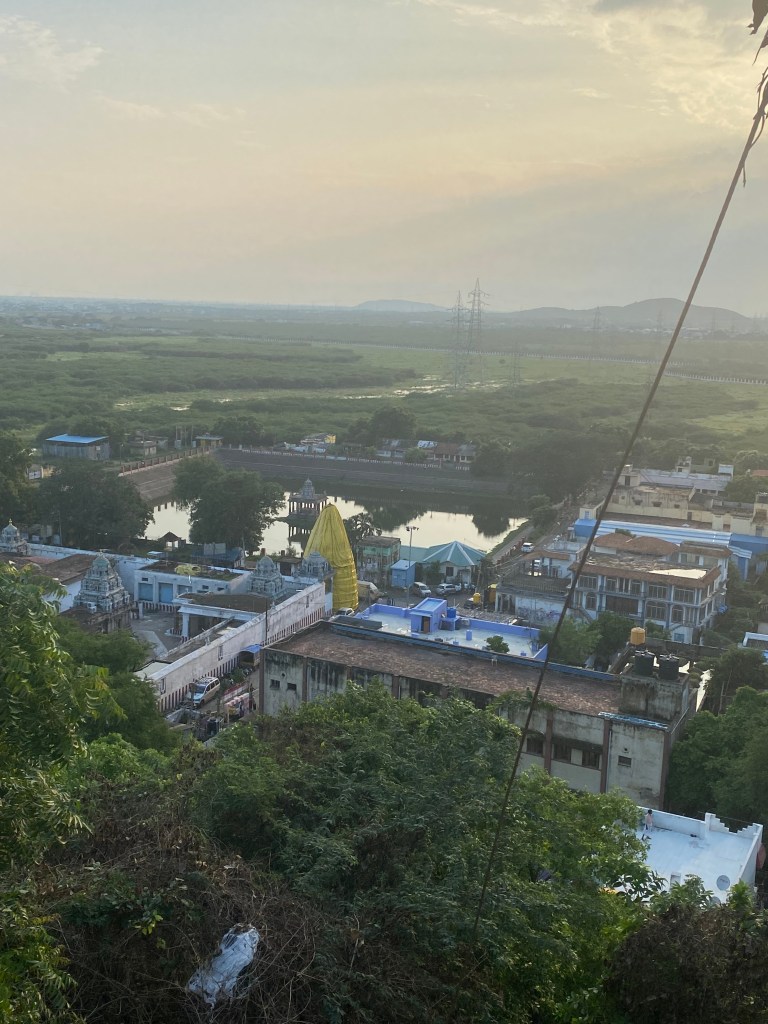
You can see the entire Pallavaram from the top of the hill; a delightful sight, and many plots are still not built into apartments. Thiruneermalai means a mountain surrounded by water; however, I could see only the Neervanna Perumal temple tank filled with water at this time.
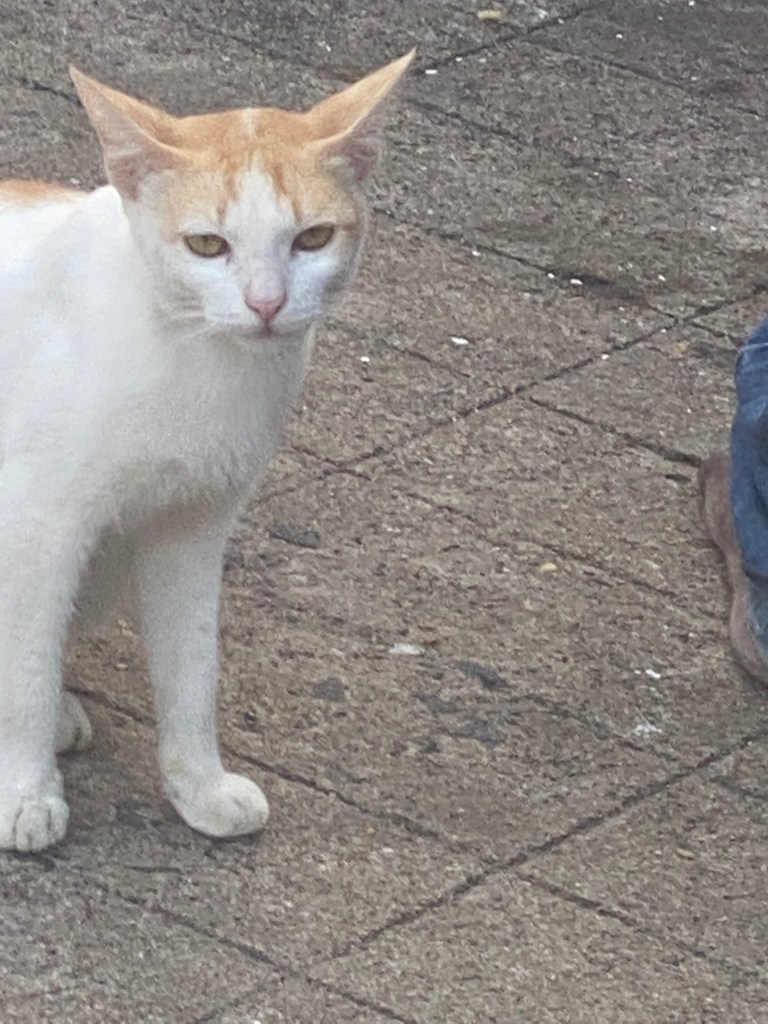
A cat that has made the temple his home
The cat that has made the temple its home
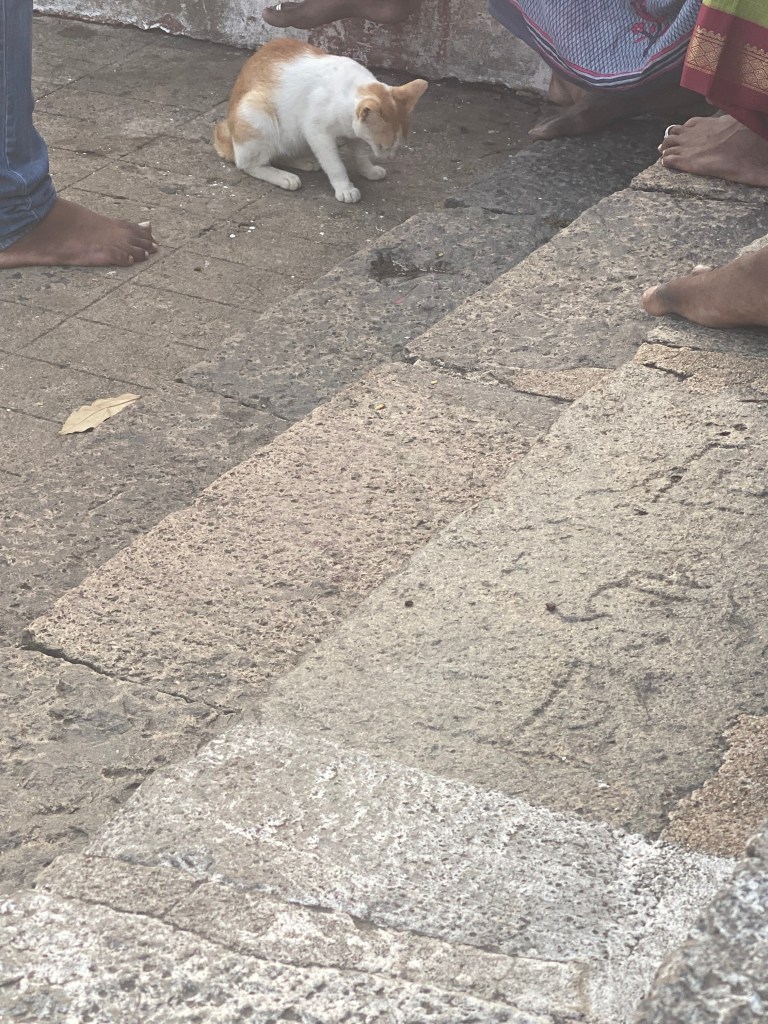
A cat had made the temple his home. He was friendly to all the visitors and allowed kids to pet him. Friendliness is unusual because cats usually choose when to let even their owners pet them. He meowed generously to ask for food from any devotee. But puliyodarai was not his preferred food; he wanted the fried murukku a little boy was eating. The boys’ parents were sensitive to the cats’ demands and pleaded with the boy to give one from his packet, but the boy did not intend to share; he did not even understand why he should share. His mother could not take it anymore and forcibly took one and gave it to the cat, and the cat was pleased. The boy roared;
The cat relishing the snack
The Neervanna Perumal Temple
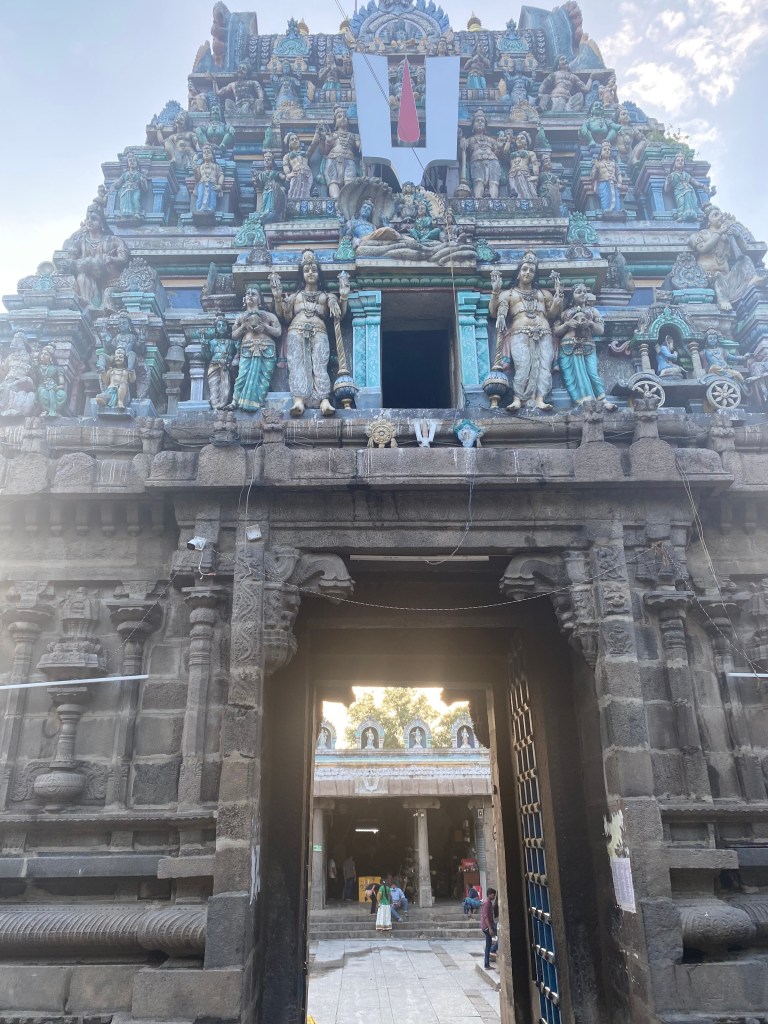
The Neervanna Perumal Temple Entrance
The Neervanna Perumal Temple is to the left once to descend from the hill. The main sanctum, the Lord of the place, Shri Neervanna Perumal shrine is on your right as soon as you enter the temple. Neervanna Perumal is standing in all his glory. For a minute, Neervanna Perumal reminded me of Lord Venkatachalapathi in Tirupathi. The next sanctum is that of Animamalar Mangai Thayar, followed by Lord Rama’s shrine.
The Temple Background
The wallpainting with a brief history of the temple
The brief history – translated from Tamizh to English
The temple is 2000 years old and appears in the list of 108 Divyadesams. The temple’s uniqueness is that the Lord Ranganathar gives darshan in four postures – standing, sitting, reclining, and walking. Thirumangai Alvar and Bhoothath Alvar have sung verses about the Thiruneermalai temples. Thirumangai Alvar has said that visiting Thiruneermalai shrines will give the equivalent results of seeing four other Divyadesams – Nachiyar Koil, Thiruvali, Thirukudandai, and Thirukoilur. Bhoothath Alwar has equated the darshan to that of Srirangam and Thirupathi. The Lord Ranganathar has appeared on the behest of the Sage Valmiki, Sage Brigu, and Sage Markandeyar. It is said that during the Dwapara Yugam, there were only two hills – Apokilam and Thiruneermalayil. Narasimhar is supposed to have appeared at Thiruneermalai when Arjuna conducted an Ashwamedhayagam after pralaya. Therefore, the sacred place is also known to grant your wishes and prayers.
Return from the temple
Having discovered such a legendary temple in our backyard that houses Lord Vishnu in four postures from different yugas or periods does fill your heart with joy. I plan to go back as many times as possible. I shall also collect more information from the temple and provide deeper details here.
As I mentioned, a few marriage halls are near the temple. The right that we had taken from the Pallavaram Junction earlier got chockablock while returning. We got stuck there as several incoming vehicles, which we believe were transporting the guests going to the marriage receptions. We got stuck there for almost 45 minutes. Once we hit the highway, we reached home in half hour.
Do visit the temple.
Share the page/post with someone who would benefit by knowing about this page/post